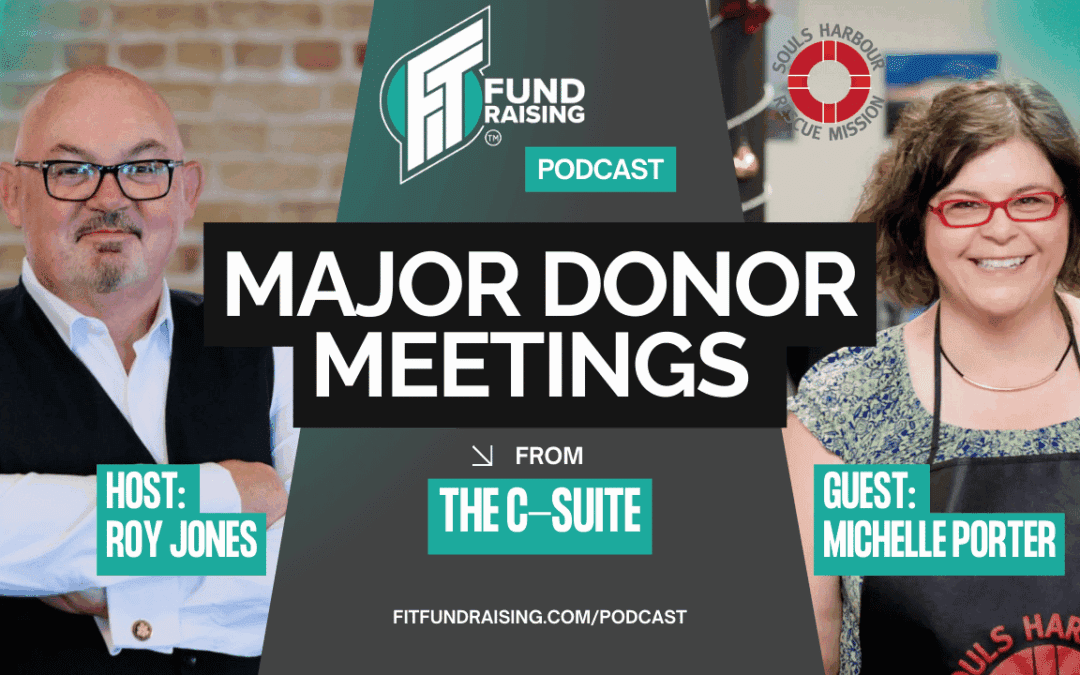
Welcome to the Fit Fundraising Podcast, where we bring you game-changing fundraising topics direct from our meetings with major donors and nonprofits nationwide.
We don’t interview consultants who haven’t met a donor in decades. Fundraising stays on the front lines with nonprofit donors and leaders. This podcast is a glimpse into our work with nonprofits as we get on the field with them and successfully model fundraising.
Get ready to get fit with the hottest show in fund development—Fit Fundraising.
Roy Jones
Well, welcome to the Fit Fundraising Podcast. Today we’re going to talk about launching your major gift program—or what I like to say is blooming where you’re planted.
Every program is different. Every organization is different. There are some common practices and best practices that we use from one nonprofit to the next. The very first lesson people have to understand is: your program starts right where you’re at.
I first met Michelle Porter close to ten years ago—just a delightful person. I’ve heard her say often that hope begins with a meal, and you’re going to find out more about that today.
That conviction led Michelle to sell everything she owned in order to invest and build what now has become Souls Harbour Rescue Mission—a province-wide response to poverty, homelessness, and addiction in Nova Scotia, Canada.
What started with one hot meal has grown into a network of 12 sites, including drop-in centers, addiction recovery campuses, supportive housing, mobile outreach, and social enterprise thrift stores—serving our most vulnerable neighbors with welcome, hope, and dignity.
As CEO and co-founder, Michelle has led a team of more than 160 staff and countless volunteers who deliver over 2 million meals, provide shelter, and help hundreds reclaim their lives from addiction.
Under her leadership, Souls Harbour has grown by more than 30% annually since its founding—becoming now a $17 million-a-year mission. Her focus is on building the systems and leadership structure to sustain expansion across multiple provinces.
Michelle brings more than 35 years of experience in Canada’s inner cities, where she’s seen firsthand both the devastation of poverty and the resilience of those who rise up out of it.
Michelle, thanks for joining us today. It is such an honor. Before we get into what you learned in launching a major donor program, take a few minutes and tell us about the work of Souls Harbour Rescue Mission—your work, your locations, your staff, your clients. Give us the big picture.
Michelle Porter
Well, thanks, Roy. It’s good to be here today.
My husband and I actually started Souls Harbour in Saskatchewan and grew it to be the largest service provider to the homeless in the province. And then in 2010, we were challenged to come to the Canadian Maritimes and start a mission.
Long story short—we accepted. We sold everything we had, packed a few clothes and mementos into our Matrix, and drove 4,000 km—that’s 2,500 miles—and started a little drop-in center.
We didn’t know this… we didn’t know a soul. But we grew from one tiny drop-in center. That first day we served 18 meals, to now over 20 sites across the province, providing services for people who are in poverty, homeless, hungry, addicted, abused.
We have nine drop-in centers where we provide food and clothing. We now have emergency shelters. We have three recovery programs: a city program for men and two farm programs—one for men and one for women and children.
Roy Jones
And of course, your husband—in addition to helping you in this ministry—accomplished writer and artist. It’s unbelievable the work he does. Take a minute and brag on him.
Michelle Porter
Well, he serves not only as our co-founder, but our Chief Spiritual Officer. And he wrote a book telling the stories from Souls Harbour throughout our 30-plus-year journey.
It’s not a typical history book. It’s a book that talks about lives that have been redeemed through the ministry we’ve been able to do over these years.
Roy Jones
I love it.
What are the first things you observed or learned from donors when you met with them? What surprised you? What did you learn? Did you expect donors to push back and not want to meet with you? I’d love to hear your thoughts.
Michelle Porter
Well, you know, I’ve always tried to meet donors, but as we’ve grown bigger, I really had to become more intentional about it.
Ken and I actually worked those two years for free, full-time. And so we scaled to a $17 million budget in less than 15 years. I knew I would have to learn new ways of connecting with our donors, including bringing more people on the team to help me.
I’ve been like a sponge—trying to learn as much as I can and quickly put it into action. Really what we’re doing with your help and your team—it’s so simple. But for some reason I was worried about it.
I called you in a panic before my first series of meetings. And it turns out—you calmed me down. I went through the day, and I needn’t have worried.
It turns out I love meeting donors, and I really have been doing it all along—just not in a systemized way. That, for me, was really important because it allowed me to step into this new angle to the ministry—to donors.
Roy Jones
I remember that. So often people delay formally launching their program because they think:
“Staff has to grow,” or “I need to hire a full-time professional fundraiser,” and then it’ll make sense to create an actual fundraising plan.
My recommendation—and it’s the same recommendation I give to everybody—is bloom where you’re planted.
The great thing about major gift programs is they teach philanthropy to all of your program staff. It teaches philanthropy and stewardship to the clients you serve. And just as importantly—and I think a primary purpose—is to teach philanthropy to the donors that give.
Tell me about your initial fears of getting started with just the team you have, as opposed to beginning by hiring a hired gun—a full-time professional major gift officer. How different was that model approach for you?
Michelle Porter
Well, we actually don’t have a big fundraising team. So at your recommendation, we’re involving everyone in the process.
Our grant writers are doing tours. Our data care manager—the person typing in the donations list—is doing tours. I love it.
And yeah, we’ll be integrating others from other departments in the next little while here—what I’m calling phase two. We’re even including the C-suite.
I don’t know if that’s the right strategy, but it is a strategy that’s working for us at this stage of our growth. It’s providing this shared burden, but also a shared understanding and partnership in raising funds.
We’re all learning philanthropy together.
Roy Jones
That’s right. And it raises more money. As donors understand that people in the ministry—your clients and the people involved in your programs—understand the stewardship process, they give more, they participate more, they buy in more.
And don’t get me wrong—our audience out there, we’ve had over 10,000 iTunes downloads, so I know I’ve got a few professional fundraisers out there.
There’s a point in time where you staff up—bring on professional fundraisers where that’s their full-time role. But it doesn’t have to start there, and that’s the point.
Tell me how you approached creating friendly discussion—relaxed conversations. I don’t want to call it elicitation, because in our first phase we were focused more on friend-raising than fundraising. Talk to me about that process, and how donors reacted to it.
Michelle Porter
What we did is we worked with our whole team, and we called everyone who’s ever given us a one-time gift of $1,000.
We were like, “Well, where do we start?” There’s a good place.
We actually did not have a lot of money—major donors. And you were quite surprised, having been around for 15 years, that we needed some work in that department. So we started with a thousand.
I already knew a lot of these donors because I’ve been inviting them to every grand opening we’ve ever had. With three new facilities this year, that gave us an excuse to call them even more. So it ramped up.
Now we were able to make that second call as a follow-up—because they would come to the opening, I would meet them, and now we’re calling again.
We sent an email—you had me writing all monthly CEO love letters—
Roy Jones
Oh, love letter.
Michelle Porter
It’s awesome. I love it.
So I sent them and said I’d love to meet them one-on-one in my office. I have a small gift to give them, and my team would follow up with a phone call to book a time.
And wow—they responded.
So the team puts a pylon out front because we’re downtown and there are only two spa—parking spots. They give them a tour, they wind them up the three-story building, and they end up in my office.
Sometimes the chef gives them a donor—or a soft lunch—for them to eat later at home, and they take it. It always makes me laugh.
Then the staff that gave the tour offers coffee, tea, hot chocolate, water—and they bring a plate of shortbread, maple leaf cookies, and a couple of chocolates.
None of that gets eaten. Weirdly. But they always take the chocolates home in their pocket, which I find funny.
So then the staff member—the tour guide—waits in the common area while we chat for 30 minutes or so.
On my desk is the small gift, wrapped fancy, with a thank-you card written by one of our residents.
We sit, we chat—and let me tell you, it is so easy and it goes fast.
I love to hear about their life, and I watch for an opportunity to ask them, “Why do you give to Souls Harbour?” Find their why.
And I tell them, “You are one of our most generous givers that we have. That’s why I wanted to sit with you personally.”
Then I ask: “What makes you give?”
In a lot of cases—and maybe it’s because we’re founders and we have a higher retention rate—they’ve been giving for over ten years.
So I ask: “What keeps you giving? What is it that floats your boat?”
It’s amazing.
Roy Jones
It is interesting. To break that process out:
You involved your program staff—not full-time fundraisers. You wanted them to learn philanthropy before they start soliciting gifts. They’re learning. They’ve been calling people, writing people, doing thank-yous, building relationships.
Then they set up the meeting with the CEO.
And I want to circle back to the CEO love letter in just a minute.
But they’ve touched these supporters a couple times—some real conversations, others voicemails or emails. Then they set up a tour and a sit-down with you.
You also mentioned a handwritten thank-you note from one of your clients. So you involved people from the program. You taught stewardship to your clients—that we say thank you and help them understand how this is paid for and supported.
Then you listened to the donor.
So you really ministered to three groups of people.
I love how you focused on finding their passion—what’s their one thing.
What was the most prevalent “one thing” that jumped out about your ministry?
Michelle Porter
Surprisingly, it was the basics—food, clothing, and shelter.
Now, we’re in the beginning stages of this process, so I haven’t met with hundreds of people yet. But honestly, 90% are doing it because they can’t bear the thought of someone not having a place to sleep at night.
Roy Jones
Very interesting.
You mentioned the three new facilities—some of that is housing, right?
Michelle Porter
Yeah, some of that is housing. We have transitional housing, but we also have emergency shelter as well.
Roy Jones
These donors—some of your top supporters—made single gifts of $1,000 or more. You had some fives, a few tens, and some bigger donors in there too.
But they started out giving through your direct response program—email, direct mail.
You don’t pull them out of that communication stream, correct?
Michelle Porter
We don’t pull them out of the stream, but we do adjust their giving levels—what we ask them for.
Roy Jones
Oh, very—
Michelle Porter
Good. Basically.
Roy Jones
Yes. As they climb the ladder, you adjust the gift arrays to align.
Michelle Porter
We either adjust the gift array, or we put up a blank line and let them fill their own number.
Roy Jones
Go to the open ask—yes. That is the industry best practice.
People sometimes think response rate drops when you do that. It does not. What happens is you increase the average gift when you allow somebody with capacity to self-designate how much they want to give, as opposed to giving only suggested amounts.
It’s really interesting seeing this journey—hearing about your team, how you’ve involved clients.
We’re going to get into more details of this process. It really is touching to think that donors who’ve been giving are now coming, touring, and sitting down with you.
What were the biggest questions they had for you?
Michelle Porter
First, I’ve got to tell you a funny story.
We got our residents—we have nine in our city recovery program—and they’re doing these cards, right? And one of them just loves it. Excellent handwriting.
He says, “This next one is going to be a tearjerker. This is going to make your donor—”
Roy Jones
So he starts telling you a story.
Michelle Porter
He did. It was excellent.
Yeah. I think you can have some fun with it too, right?
Roy Jones
And it helps them understand: you only get by asking. And it’s about appreciating the donors and understanding stewardship.
I say this not only to my faith-based clients, but I truly believe this is God’s matrix for stewardship.
He enables people to earn money—to amass great wealth. There are people that have great needs. And then He uses you and organizations like yours to connect the dots.
We all pray that God would send us $1 million—but God only sends people.
In this process of meeting with donors, Michelle, take a few minutes and tell about the most significant challenge you faced around organizing these structured meetings.
Michelle Porter
First, let me say meeting my donors one-on-one has been an incredible experience, and I can’t believe I haven’t done it up until now.
I’m a people person all the way, and I enjoy meeting people who are investing in Souls Harbour.
And I found that most people are giving because they can’t stand the thought of someone not having enough to eat or not having a place to sleep at night. They want to help meet basic needs.
But one of my personal challenges is that I’m not actually a good storyteller—and you’ve got to be good at telling stories to raise awareness and funds.
So I have to do mental preparation. I need to look at their file. I need to see if we’ve been in communication before, what events they’ve been to, and what their interests might be in the community.
Taking all that into consideration, I didn’t expect the meetings would be so tiring.
The first time I did this, I loaded up my week with meetings top to bottom. It was an experiment—and it was exhausting. It takes a lot of mental energy.
So needless to say, we’ve pared the meetings down and slowed the process down a little bit.
Roy Jones
Yeah, it is really interesting.
Michelle, we’re going to wrap this session up. I’m going to have you back for a second episode. I want to thank you for joining us today.
And again, I want to thank all of our listeners. Thank you so much.
If you’d like help launching or focusing or relaunching your major gift program, I hope you’ll call us here at Fit Fundraising.
Last year, we helped more than 25 nonprofits with free fundraising counsel. Fifteen of those—one of them, like Michelle—actually ended up putting us on retainer for regular coaching and counsel because of the additional revenue and value we helped bring to their clients.
So again, thank you for joining us. Thanks for being part of the Fit Fundraising broadcast. I hope you’ll call us. Look forward to catching you in the future.
Thank you again for joining us here today.
Narrator
Thanks so much for listening to the Fit Fundraising Podcast. Please make sure to subscribe on your favorite podcast app so you’ll be notified of future episodes.
And as always, make sure to visit FitFundraising.com to get your fundraising program into shape.
Thanks so much for listening to the FIT Fundraising Podcast. Please make sure to subscribe on your favorite podcast app so you’ll be notified of future episodes. And as always, make sure to visit fitfundraising.com to get your fundraising program into shape.
- Follow Us: Facebook | LinkedIn
- Subscribe to the Fit Fundraising Podcast: Apple Podcasts | Spotify
- Visit our Website at fitfundraising.com