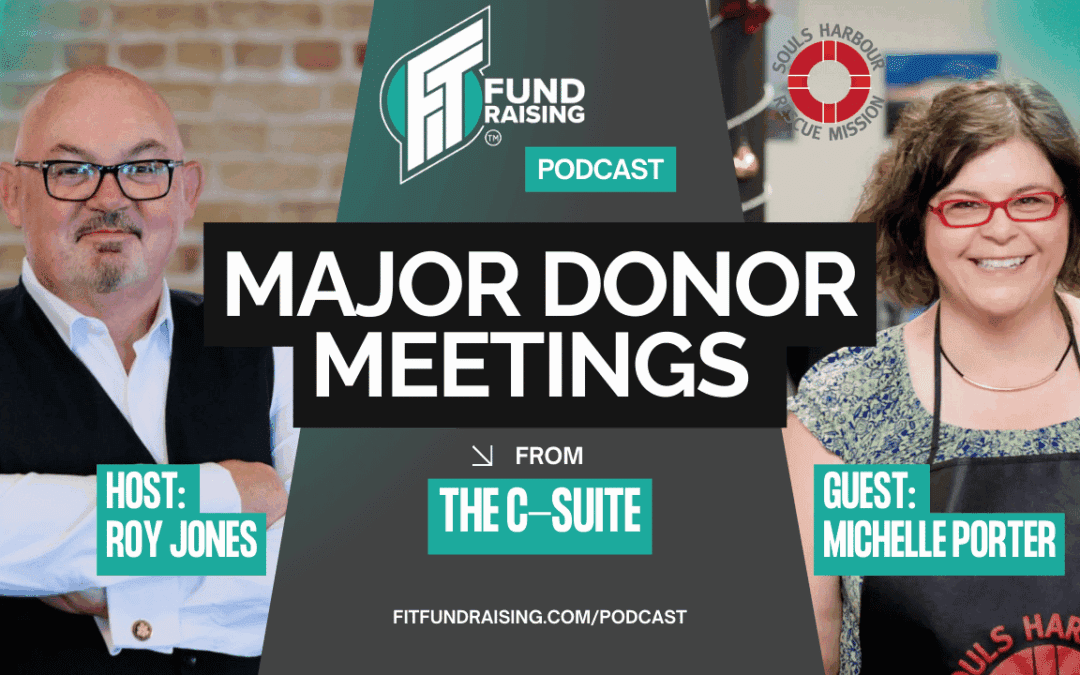
Welcome to the Fit Fundraising Podcast, where we bring you game-changing fundraising topics direct from our meetings with major donors and nonprofits nationwide.
We don’t interview consultants who haven’t met a donor in decades. Fundraising stays on the front lines with nonprofit donors and leaders. This podcast is a glimpse into our work with nonprofits as we get on the field with them and successfully model fundraising.
Get ready to get fit with the hottest show in fund development—Fit Fundraising.
Roy Jones
Welcome to the Fit Fundraising Podcast. I’m so glad you joined us. We have a wonderful interview today. We’ve been talking about how to launch a major giving program. Maybe you’ve launched one already. Maybe you need to relaunch it, refocus it, or rethink it altogether. But I want you to hear this clearly: you need to start now.
Today we have a fantastic guest who has been through this exact process.
I’ve heard Michelle say this often: hope begins with a meal. We’re going to unpack that today with Michelle Porter. That conviction led Michelle to literally sell everything she owned so she and her husband could create Souls Harbour Rescue Mission. She’ll share the history in just a moment, but in short, it’s a province-wide ministry addressing poverty, homelessness, and addiction in Nova Scotia.
What started with one hot meal has grown into a network of more than a dozen sites, including drop-in centers, addiction recovery campuses, supportive housing, mobile outreach, and social enterprise thrift stores. Today, Souls Harbour serves the most vulnerable neighbors with welcome, hope, and dignity.
As CEO and co-founder, Michelle leads a team of more than 160 staff and countless volunteers who deliver over two million meals, provide shelter, and help hundreds reclaim their lives from addiction. Under her leadership, Souls Harbour has grown by more than 30 percent annually since its founding and is now a $17 million mission. Her focus is building the systems and leadership structures needed to sustain growth across multiple provinces.
Michelle brings more than 35 years of experience serving Canada’s inner cities, witnessing firsthand both the devastation of poverty and the resilience of those who rise above it.
Michelle, thank you so much for joining us today. I truly appreciate you being here.
Michelle Porter
Thanks for having me, Roy, and thanks for that introduction. If people want to learn more, they’ll have to listen to part one.
Roy Jones
That’s right.
It’s been fascinating watching your journey through this process. You’ve been deeply embedded in your community, involved in public relations, advocacy, and leadership around homelessness. But it’s been especially interesting to see how you’ve layered major gifts on top of your existing fundraising channels—your direct response program, your web presence, your strong direct mail efforts.
This major gift component has been a significant addition. Take a moment and describe your philosophy going into these meetings. How did you feel about them? How do you think they help donor retention? Are you seeing donor upgrades? And why is requesting and holding these meetings so important?
Michelle Porter
I think people might look at our organization today and ask, “You have 170 staff and a $17 million budget. Why weren’t you doing major fundraising already?”
What they don’t see is that almost all of that growth has happened in the last two or three years. We’ve exploded across the province of Nova Scotia. At this point, it’s obvious that direct mail alone isn’t enough.
I’m also realizing that I can’t do this alone. Right now, we’re calling and meeting with anyone who’s ever given a one-time gift of $1,000. But as we grow, I won’t be able to manage that myself. And what’s surprised me is how excited people are to meet.
They make me feel like a celebrity. They’ll say, “I’ve seen you on Facebook Live,” or “I read Ken’s book.” I try to remind them that I’m not the hero of the story—they are. There is no Souls Harbour without the donor.
We’re very new to this process. Right now, we’re focused on meeting people, learning what they love most about Souls Harbour. Eventually, we’ll ask for more specific gifts. But even now, we’re already seeing an increase in giving.
We tell them, “This isn’t a fundraising meeting. It’s just a visit with Michelle.” And they show up with a check or say, “I’ll mail one next week.” And they do.
Roy Jones
That happens all the time. Or they ask what your needs are, and the conversation naturally unfolds.
Industry best practice tells us that major donors—especially five-figure donors—should have an annual meeting. Not a pitch meeting. Not an arm-twisting session. But a meeting focused on gratitude, impact, and partnership.
You’ve talked before about how this process has shifted the mindset of your program staff and even your clients—how it’s helped them understand stewardship and philanthropy, and how clients are excited to write thank-you notes.
If I asked one of your donors, “What did you learn from your meeting with Michelle?” what do you think they’d say?
Michelle Porter
They’d probably say I’m very busy but very friendly.
One donor told me, “You probably do this all the time.” I said, “I’ve never asked anyone for money before. This is brand new to me.” They were shocked.
I think they’d also say I’m the same person they see on Facebook Live—that I’m genuine.
Roy Jones
That authenticity matters. Transparency and honesty are what people respond to.
This isn’t an easy process. You call 10 or 20 people and maybe only two or three respond. That’s hard on staff. What did your team learn from going through this?
Michelle Porter
I was honest with them from the beginning. I told them I was nervous, even though informally I’ve been doing this for years. You don’t grow from zero to $17 million without talking to donors.
Involving staff early created buy-in. We’re learning together what donors care about and how to make them feel valued.
We realized we weren’t ready to rush ahead. Instead of treating this as a one-time project, we chose to move slowly, evaluate, tweak, and improve. That’s helped cement these lessons into our habits.
Roy Jones
You had 10 to 15 staff on your weekly development calls—none of whom planned careers in fundraising. Suddenly they’re thanking donors, learning stewardship, and setting meetings.
What did you learn from the donors themselves?
Michelle Porter
I learned that donors respect my time. They assume I’m busy and appreciate the effort to meet.
They’re also just as nervous as I am.
They love tours, even if they’ve been here before. They value the one-on-one attention. They come prepared, having read newsletters and materials. Many are amazed when they see the scope of our growth—22 sites across the province.
Next, we’ll introduce project lists: small, medium, and large projects in each town. And yes, I guess I’ll finally ask them for money. I’m trusting you to teach me how.
Roy Jones
They’ll often ask themselves. It’s a conversation, not a pitch.
Once you align a donor’s passion with a real need in their community, that’s where the magic happens. You’ll move from organic growth to strategic growth.
Michelle Porter
That sets the stage perfectly for phase two.
Roy Jones
And this process never stops. We’re not just training staff and clients—we’re training donors. Annual planning meetings become the norm.
Most of the biggest gifts happen in the second meeting, not the first. Too many organizations give up too early.
By year three, donors are calling you to schedule meetings. Trust builds. The process gets easier.
Michelle Porter
I love that. There’s a lot to look forward to.
Roy Jones
Let’s talk about perceptions. Were these “wealthy” donors what you expected?
Michelle Porter
Not at all.
One woman I visited looked like everyone’s grandma—hand-knit scarf, winter hat, older coat. I wondered if we had misjudged. It turned out to be my favorite visit and likely one of the wealthiest donors I’ve met.
Roy Jones
You really can’t judge by appearances. Many people see their purpose as stewarding resources to give back.
Did these visits impact donors and staff?
Michelle Porter
Absolutely. Donors leave encouraged and hopeful. It’s the same feeling we want our guests to leave with.
For staff, it opens their eyes. Fewer assumptions. More curiosity. More care in communications.
Roy Jones
That leads perfectly into the CEO love letter concept—personal, insider communication written one-to-one.
You’ve embraced this with your “Note from My Ready Room,” which I love.
Michelle Porter
I wanted it to feel authentic. And yes, I’m a Star Trek fan.
Roy Jones
Picard and Janeway—excellent choices.
As we wrap up, where do you see the biggest growth opportunity?
Michelle Porter
Major gifts, without question.
Getting comfortable. Knowing our numbers. Telling impact stories consistently. Training staff. Eventually bringing in fundraising professionals.
I picture our team like a well-run McDonald’s kitchen—fast, coordinated, and intentional. Everyone knows their role. That’s the system we’re building.
Roy Jones
That’s a powerful image. Year one is the hardest. Don’t give up.
Stay the course. The biggest growth happens between year one and year two.
Michelle, thank you for your transparency, leadership, and courage.
Michelle Porter
Thank you. If anyone wants to reach me, visit soulsharbour.ca. Harbour is spelled the Canadian way—with a “u.”
Roy Jones
Fantastic. Thanks again to Michelle and to all our listeners. If you need help launching or refocusing your major gift program, reach out to Fit Fundraising. We’d love to walk with you through the process.
Thanks for listening. We’ll see you soon.
Narrator
Thanks so much for listening to the Fit Fundraising Podcast. Please make sure to subscribe on your favorite podcast app so you’ll be notified of future episodes.
And as always, make sure to visit FitFundraising.com to get your fundraising program into shape.
Thanks so much for listening to the FIT Fundraising Podcast. Please make sure to subscribe on your favorite podcast app so you’ll be notified of future episodes. And as always, make sure to visit fitfundraising.com to get your fundraising program into shape.
- Follow Us: Facebook | LinkedIn
- Subscribe to the Fit Fundraising Podcast: Apple Podcasts | Spotify
- Visit our Website at fitfundraising.com