Welcome to the Fit Fundraising Podcast, where we bring you game-changing fundraising topics direct from our meetings with major donors and nonprofits nationwide.
We don’t interview consultants who haven’t met a donor in decades. Fundraising stays on the front lines with nonprofit donors and leaders. This podcast is a glimpse into our work with nonprofits as we get on the field with them and successfully model fundraising.
Get ready to get fit with the hottest show in fund development—Fit Fundraising.
Roy Jones:
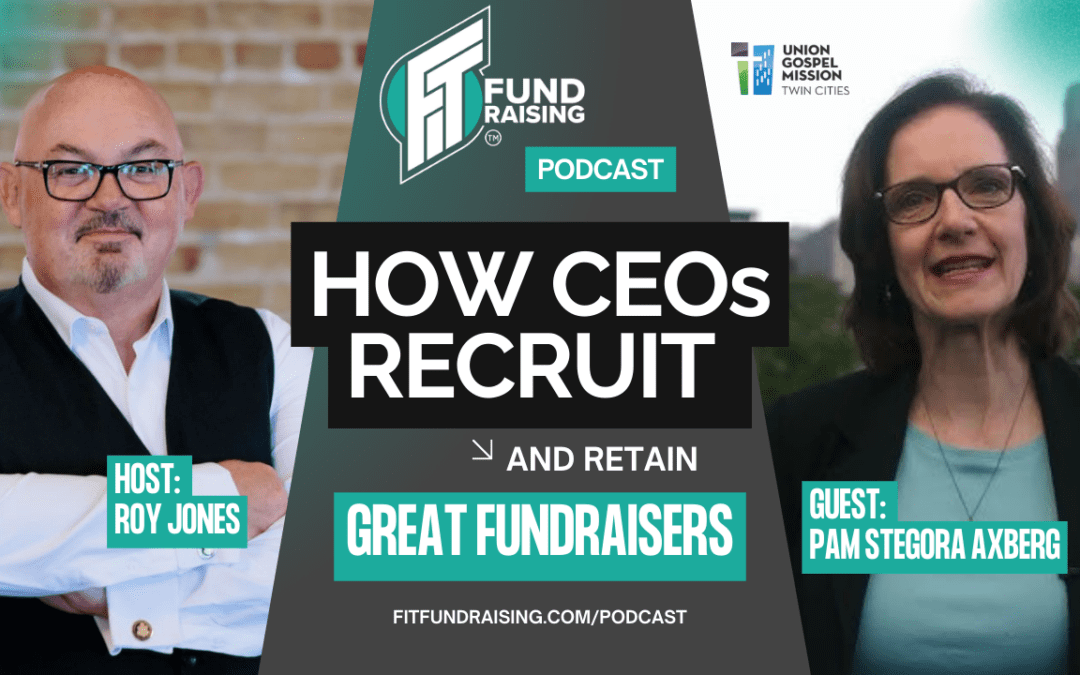
I’m Roy Jones and thank you today for joining the Fit Fundraising Podcast. We’ve got an exciting episode for you. I am so glad you joined us. Staffing, recruiting, and how we do outreach to donors is a really important topic and nonprofit leaders all across America are struggling with staffing today. I am so honored that Pam Axberg has joined us.
She’s the CEO of Union Gospel Mission Twin Cities in St. Paul and Minneapolis. The organization raises more than $20 million annually to make sure that hungry people are fed, people experiencing homelessness are sheltered, and hurting people are given the tools to change their lives. Most importantly, everyone who comes to UGM Twin Cities encounters the good news of God’s love seven days a week, 365 days a year.
Prior to coming to UGM Twin Cities in 2020, Pam was a senior executive at United Healthcare and Optum for more than 14 years. She held several executive leadership roles including managing national strategic partnerships, transforming provider-patient experience, and national and international operations. Before that she spent over 20 years with Quest Communications where she was a senior vice president and an officer in the company.
Pam is an advocate for the development of girls and women’s leadership. She has served on many boards including Women Business Leaders in Healthcare, Girl Scouts River Valley, Junior Achievement, and TopLine Credit Union. She currently serves as a council member for the City of New Brighton.
Pam, thank you so much for joining us today. I want to talk about a lot of subjects and I’d love for our audience to get to know you a little bit.
Pam Axberg:
Roy, I’m so happy to be here. It has just been a privilege to work with you and have you be an advisor to me along this journey of how we steward donors and what that looks like.
Union Gospel Mission Twin Cities exists to provide life-transforming, Christ-centered pathways for people experiencing homelessness, hunger, and addiction. Every day I wake up and ask how we can help the most vulnerable people in our community. We are able to do that because of so many generous donors.
Roy Jones:
I happened to be there one morning when you were having a meeting with your C-suite peers. Talk to me about how you manage executives at that level. Is it weekly meetings? Daily meetings? Individual meetings? How does that process work?
Pam Axberg:
We hold a weekly leadership team meeting and the word team is important because it is not just my agenda. The value is that everyone hears the same information and everyone has a chance to weigh in.
My team may have a pulse on something or insight where I might have a blind spot. If I do not hear from them collectively then I am not making my best decision.
The first item on our agenda is always recognition. I expect people to do their jobs well but I am always looking for problems to solve. Starting with recognition helps us begin the meeting on a positive note. Anyone can share a success story. Sometimes we even write a recognition card on the spot.
It helps me learn insights about the organization and it sets a good tone for the meeting.
Then we move into the agenda items and everyone can bring topics forward. The wisdom of the team is better than trying to do it alone. I also hold one-on-one meetings and we review budgets and scorecards monthly. You get what you measure and people need to understand their dependencies.
The higher you are in leadership the more you depend on others for success.
Roy Jones:
That is so true. Talk to me about metrics. How does that relate to the development team? The metrics there are very different from other departments.
Pam Axberg:
Everyone in the organization has annual goals. For development we also include communications and marketing because those areas feed the pipeline.
Volunteers feed the pipeline for donors and communications reinforces what donors think about the organization.
I look at a suite of metrics because a single metric alone can be misleading. I want to see the balance of metrics.
For example I look at retention, especially among mid-level and major donors. I look at total revenue. I look at the number and value of monthly gifts because recurring giving is an important trend. I also look at average gift size.
Then we review initiatives to see whether we have the right strategies in place.
Roy Jones:
You mentioned recognition earlier. How do you recognize frontline fundraisers? In the business world they might earn commission but nonprofits usually do not operate that way.
Pam Axberg:
We do not use commission but we do use performance-based merit increases. First, I try to ensure we are paying competitive salaries because we want to attract top talent.
That is one reason I chose to use a recruiter. Development is a specialized field and I knew I did not have the time or reach to find the best candidates on my own.
Roy Jones:
So you would recommend that to other nonprofits?
Pam Axberg:
Absolutely. Development is a niche and you need someone who understands that niche.
A development officer is not just a development officer. The skills and experience need to match what your organization needs now and where you want to go.
In addition to compensation we also reward success with professional development opportunities. That could mean conferences, training, mentoring, or other growth opportunities.
Another thing we did was encourage senior leaders to invite people to our gala. I created a small raffle drawing as an incentive. The point was not whether someone came or not. The point was to encourage leaders to ask.
When leaders ask, it models behavior for everyone else.
Roy Jones:
You are building a culture of philanthropy.
Pam Axberg:
Exactly. The shadow of the leader matters. People watch what leaders do and what they do not do.
If leaders are talking with donors and inviting donors into the mission then others will follow.
Sometimes I even have to give myself a pep talk. There are mornings when I would rather stay in my office but I remind myself that my job is to walk across the room and talk to people.
Roy Jones:
That ties into donor retention. There is also a retention problem with development staff in the nonprofit sector. Many people move jobs every 12 to 18 months.
How do we keep good development staff for five or ten years?
Pam Axberg:
First, we must be competitive with compensation. Your best performers are often the first to leave if they feel undervalued.
You also have to make their work meaningful and ensure they are set up for success. They need to see a path for growth and development.
Another important lesson I learned is that the caliber of people we want are already working somewhere else and doing good work. They will move for the right opportunity but they will not put themselves at a financial disadvantage.
I want candidates to be excited about the mission and the impact they can have here. When that is the case, salary becomes a smaller part of the conversation.
Roy Jones:
Development staff often pay for themselves quickly if the right systems and strategies are in place.
Pam Axberg:
Exactly. At the end of the year about 52 to 56 percent of our revenue comes in. Our development team made around 2,000 donor calls. Some donors had not been contacted in a long time and they appreciated the call.
Sometimes it is not the perfect timing but it is better than no timing. Perfect should not get in the way of doing something good.
We simply call, thank them, and ask if they have any questions or need more information. Many calls go to voicemail but the invitation is still there.
We are solving for long-term relationships, not just short-term outcomes.
Roy Jones:
Pam, thank you so much for joining us today. If listeners want to reach out to you, how can they do that?
Pam Axberg:
You can email me at paxberg@ugmtc.org. I answer my own email.
Donors often give wisdom along with their gifts and we just have to listen. I am always open to learning from others and finding ways we can help each other.
Roy Jones:
Thank you again for joining us today. We release a new podcast every two weeks covering important topics in fundraising.
If you need help with anything please reach out to us at fitfundraising.com. Last year we helped more than 50 nonprofit organizations with free fundraising counsel.
We are here to help and serve. Thanks for listening to the Fit Fundraising Podcast.
Narrator
Thanks so much for listening to the Fit Fundraising Podcast. Please make sure to subscribe on your favorite podcast app so you’ll be notified of future episodes.
And as always, make sure to visit FitFundraising.com to get your fundraising program into shape.
Thanks so much for listening to the FIT Fundraising Podcast. Please make sure to subscribe on your favorite podcast app so you’ll be notified of future episodes. And as always, make sure to visit fitfundraising.com to get your fundraising program into shape.
- Follow Us: Facebook | LinkedIn
- Subscribe to the Fit Fundraising Podcast: Apple Podcasts | Spotify
- Visit our Website at fitfundraising.com